Spring Snowmelt and Steel-Era Basements: What Youngstown-Area Homeowners Need to Know
Spring snowmelt drives groundwater into Mahoning Valley basements every April. Steel-era block foundations take it worst. Here's the honest fix order.
Published · By Dominic Petrucci
Why Do Youngstown-Area Basements Flood During Spring Snowmelt?
Spring snowmelt floods Youngstown-area basements because the frozen ground finally thaws and releases the water it held all winter, right as April rains stack on top of that. Groundwater table rises, hydrostatic pressure pushes against old block walls, and 1900 to 1940 steel-era foundations take water through every mortar joint, every hollow core, and every hairline crack at once. If your basement only floods in spring, this is why.
What Makes Steel-Era Basements Different
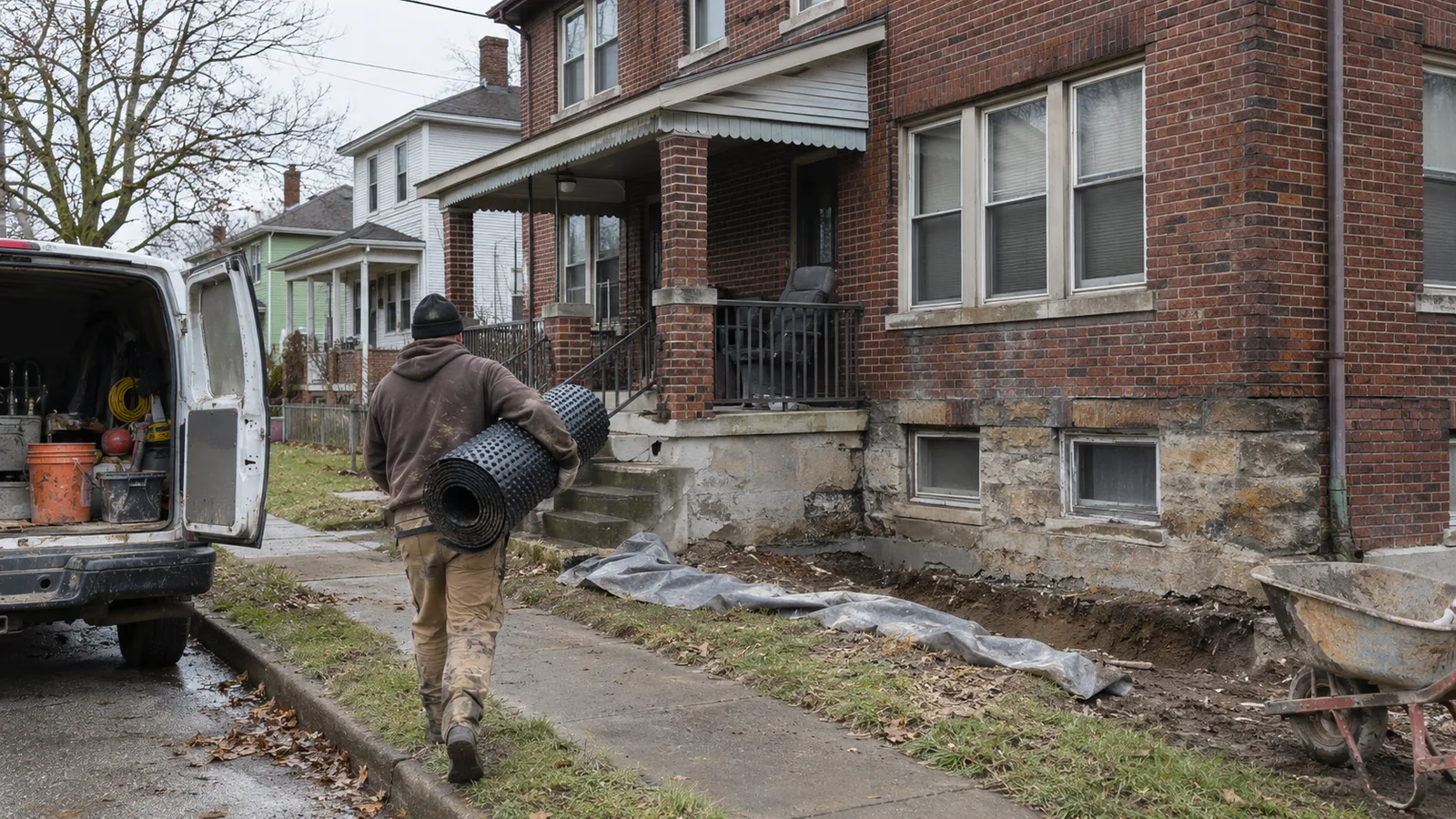
The housing stock built to house Mahoning Valley mill workers in the early 1900s through 1940 was built fast, cheap, and on whatever soil the lot sat on. Hollow clay tile block was a common foundation material then, and so was early poured concrete without modern reinforcement or waterproofing membranes. There was no dimple board, no vapor barrier, no modern footing drain. The original drainage system, if there was one, was clay tile buried next to the footing that collapsed decades ago.
The other thing about steel-era basements is the fill. Lots in Campbell, Lower Struthers, the south and east Youngstown blocks near the old mill sites, and anywhere within a mile of Republic Steel or Campbell Works carry slag, cinders, and industrial fill mixed with native clay. That fill holds water against the footing like a sponge, and native clay underneath drains slow. Combine those two and you have a wall that is basically soaking from both sides every April.
The Snowmelt Math
A typical Mahoning Valley winter drops 40 to 70 inches of snow, most of it between December and February, and most of it melting in March and April. On a 1,500 square foot lot, that's 3,750 to 6,500 cubic feet of water released over 6 to 8 weeks, plus whatever April rain stacks on top. Clay soil holds most of that water during the melt instead of draining it. The water table around a Struthers or Campbell foundation can rise 2 to 4 feet between early March and late April.
That rise is what forces water through your basement wall. Hydrostatic pressure at the bottom of a 7 foot wall under a saturated water table can push 300 to 450 pounds per square foot against the wall. Hollow clay tile cores don't stand up to that, mortar joints weep, and the cove joint where the slab meets the wall becomes the path of least resistance.
What Homeowners Should Do First
Before you pay anybody anything, do these three things on a dry day in March:
Walk the perimeter outside. Look at every downspout. If any downspout dumps water within 6 feet of the foundation, extend it with 10 to 15 feet of flex pipe. Twenty-five dollars at the hardware store. That alone solves maybe 15 percent of the spring basement calls we get.
Check the grade. Soil at the foundation should slope away from the house at 1 inch per foot for the first 6 feet. If it's flat or sloping back toward the house, that's where regrading comes in before any interior work.
Pull the sump pump lid. If you have a pump, fill the pit with a 5 gallon bucket of water and watch what happens. If the pump short-cycles, hunts for the float, or doesn't kick on, you have a problem to fix before April, not after.
When the Real Fix Is Interior Drain Tile
If after the downspout, grade, and sump checks you still take water every spring, interior perimeter drain tile and a sealed sump is the honest fix for most steel-era basements in Struthers, Campbell, and the Youngstown south side. The system cuts the slab 12 to 14 inches off the wall, lays 4 inch perforated pipe in washed gravel below the bottom of the footing, drills weep holes into every hollow core of a block wall to let the water trapped in the wall drop into the pipe, and pitches everything to a new sealed sump.
Cost in the Mahoning Valley: $4,500 to $12,000 depending on linear feet, slab condition, and pump spec. Standard job is 2 to 4 working days. Battery backup on the sump is not optional in this area at $400 to $1,000 additional, because lake-effect spring storms knock the power out on the nights you need the pump most.
When Exterior Excavation Makes Sense
Exterior excavation at $10,000 to $25,000 is worth it when you have a newer poured wall that's cracked through from outside pressure, when the yard has open access without expensive landscaping in the way, and when you want the water stopped before it ever reaches the wall. On most 1900 to 1940 steel-era block foundations, interior drain tile is the better call, because excavating around old block without knocking it down is risky and expensive.
The one time we'd push an older steel-era home toward exterior work is when there's structural damage from freeze-thaw already underway and the wall needs to be exposed for reinforcement anyway. Combine the two jobs, save the trip.
What to Ask the Next Contractor Who Calls You
Before you sign anything, ask three questions. What's the pump brand and switch type on the quote? A cast iron body pump with a dual float switch is a real answer. 'A quality sump pump' is not. What's included for weep holes on block walls? If the answer is nothing, that's not a real interior system for a steel-era basement. What's the written workmanship warranty term? Five to ten years is reasonable. Lifetime on labor is often a sales line that depends on fine print.
If your Mahoning Valley basement is already flooding or you want a free in-home inspection before the next spring thaw, our crew lead can usually be at your Struthers, Campbell, Hubbard, or Youngstown-area house inside 48 hours.